
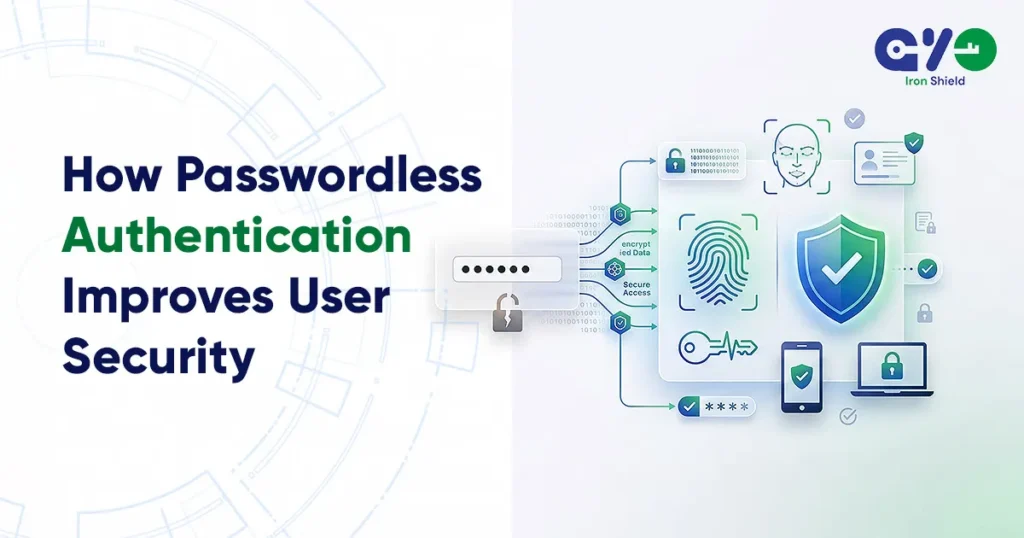
How Passwordless Authentication Improves User Security
A person may forget their password and give up on signing up. Another person who is quite impatient may try resetting their password many times before eventually being allowed to enter. However, cybercriminals may use the stolen credentials obtained from a breach of a completely different site to try to break into thousands of user accounts. For a lot of companies, authentication is not simply a security problem anymore. It clarifies, amongst other things, customer onboarding, conversion rates, customer trust, the cost of support, and platform growth. This is the reason why a lot of companies are ‘going passwordless,’ like they are adopting passwordless authentication methods. If businesses get rid of passwords from the login procedure, they will not only be able to mitigate the most frequent security risks, but they will also be able to provide their users with quicker and more dependable user journeys. What Is Passwordless Authentication and How Does It Work One of the great features of passwordless authentication is that it enables people to prove who they are without the need to first set up or type in a standard password. Instead of being based on a fixed piece of credentials that has to be memorized and secured, people may verify their identities through other means, like: For an employer, this makes the authentication process more streamlined and at the same time lessens a lot of the dangers that come with password management. Security Risks of Traditional Password-Based Logins Using passwords still leads to numerous security breaches involving authentication. But the issue is not a password alone. Besides, the biggest problem is probably the way users behave. Many users have a large number of online accounts and, to simplify their digital lives, they tend to reuse passwords across different sites, make variations that are easy to guess, or use simple credentials. Although these decisions are understandable, they lead to very serious security problems. The most usual risks are: The consequences from a business perspective can be major. Problems with passwords cause support tickets, increase the number of account recovery requests, disrupt the onboarding process, and create difficulties during login. Each failed attempt to authenticate is a lost opportunity for user engagement. For expanding SaaS platforms and eCommerce businesses, such problems could even hinder both security results and business performance. How Passwordless Authentication Prevents Credential Theft A key benefit of a Passwordless Authentication Service is the absence of permanent passwords that attackers can steal. With the usual authentication methods, once the credentials are compromised, they can be reused multiple times until the user decides to change the password. Passwordless systems eliminate such dangers by substituting the fixed credentials with either temporary or device-centered verification methods. And, in reality, if a hacker gets hold of a user’s email or phone number, it won’t be enough for them because they also have to access the verification method or the device that the user trusts for the authentication. Because of this, organizations are capable of drastically lowering their risk to: Such a transformation will ultimately help in making login fraud prevention more robust and, at the same time, lessen the reliance on users maintaining perfect password behaviors. Role of OTP and MFA in Passwordless Security OTP authentication is a key thing in many passwordless authentication scenarios. But a single verification method alone is generally not enough for modern authentication approaches. Further, many organizations use passwordless authentication in combination with multi-factor authentication to provide additional layers of protection for high-risk activities such as financial transactions, account recovery, administrative actions, or access to highly sensitive data. Companies are increasingly turning to communication channels such as WhatsApp OTP verification, and SMS OTP login as these methods provide users the ability to authenticate themselves through familiar communication platforms. At the same time, having multi-channel authentication can also be a good thing for security and convenience by offering different user identity verification paths when one channel has delivery issues. One effect of all this is greater security without the introduction of unnecessary points of user friction. How Passwordless Login Reduces Phishing Attacks Phishing attacks rank highly amongst the most successful ways for threat actors to steal user credentials. Most phishing schemes are targeted towards tricking users into feeding fraudulent login forms with their username and password. Once the attackers have these login details, they will try to gain unauthorized access to other systems. A security audit based on passwordless authentication cuts down the worth of stolen credentials as users do not share with the attacker a permanent password that could be reused later. In fact, no authentication method totally eradicates phishing threats. Still, doing away with passwords greatly increases phishing attack prevention strength. The attackers are deprived of access to one of their most valuable targets, thereby making credential-based attacks extremely ineffectual. From the point of view of businesses, this means fewer compromised accounts, less potential for fraud, and more user confidence. Why Businesses Are Investing in a Passwordless Authentication Service The business rationale for passwordless login security goes far beyond security. More and more, organizations see authentication as a part of the customer experience that matters a lot. Each time you make users go through a login step, it’s like you’re giving them a chance to leave, get angry, or call support. By employing a contemporary Passwordless Authentication Service, enterprises can: Just password reset issues result in huge operational inefficiencies. People forget their login details, teams dealing with support handle recovery requests, and customer journeys get disrupted. Eliminating passwords, businesses will remove one of the most common sources of login-related friction. Why SaaS and eCommerce Platforms Are Adopting Passwordless Login People want quick and easy mobile access to digital services more and more. Lengthy sign-up forms, password creation rules, and recovery procedures that are complicated can drastically drop conversion rates and increase abandonment. First, smooth access supports product adoption and continuous engagement for SaaS companies. But, eCommerce companies, by reducing the hurdles to account creation and checkout, can see a direct increase